

He Just Wanted to See Her
My son stood close to death for the first time

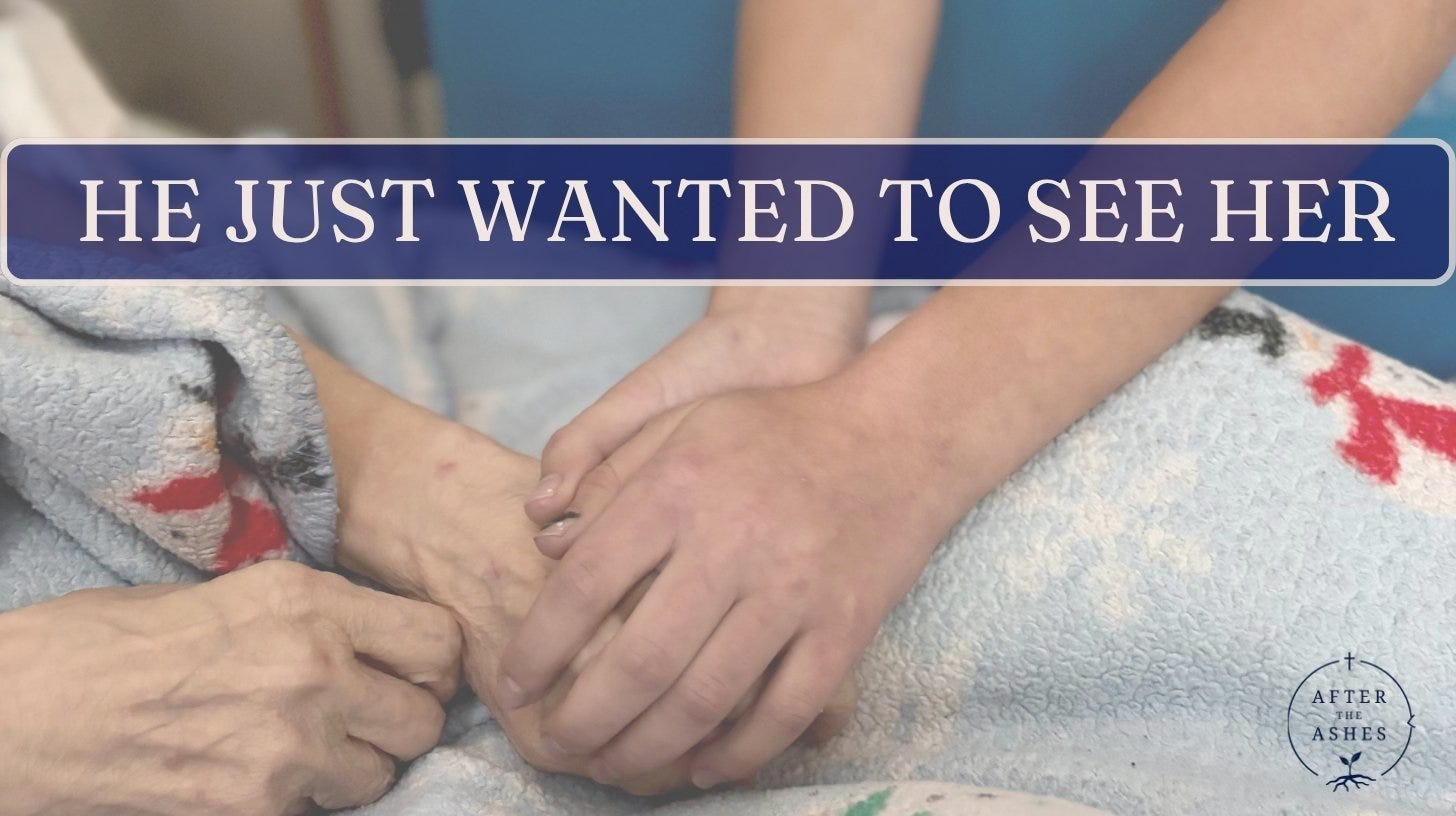
“I’m just warming up her hands,” my youngest told me during one of our visits to my dying mother’s home.
Eleven days ago, as of this posting, I got the news that my mother would likely be leaving us soon. Strangely enough, my siblings and I have been down this road with her a few times before. Let me explain.
Twenty-nine years ago, not long after we celebrated her 50th birthday, my mother walked out of a neurologist’s office with a diagnosis none of us saw coming: Parkinson’s disease. To say it was a shock would be an understatement. My mother was healthy. She’d had some trouble with her back over the years, and a knee that would probably need replacing down the road, but that was it.
Once the initial shock wore off, I did a little research on Parkinson’s and was relieved to learn that many patients live long lives with it. Things might look a little different over time — a scooter to get around, a ramp at the front door, an earlier retirement than planned, more medication — but life still went on, just in a different shape, for so many of them.
Oh, how naïve I was. All of that is true, but it’s nowhere near as simple as I made it sound.
My mother used to play the piano — and the organ — in a way that made your heart want to sing along, even when you didn’t know the words. Parkinson’s took that from her just a few years into her diagnosis.
She was a gifted, valued paralegal who’d given decades to the same firm, and she loved her work. Parkinson’s forced her into an early “retirement” on long-term disability, once her fingers could no longer keep the typing pace she’d always been known for.
Mom loved to treat my sister and me and our families to a meal out as often as she could. She loved being with her children and grandchildren, and she knew it blessed us. Over time, though, we realized that getting her in and out of our vehicles caused her so much anxiety that she decided the outing wasn’t worth it. She didn’t mind us helping her onto her scooter — her new ride — but she was terrified her legs or feet would give out and we wouldn’t catch her in time. I remember being so annoyed by that. Why couldn’t she just trust us? We weren’t going to let her fall. Shame on me for letting myself feel that.
Eventually, we moved to another city when my husband was transferred for work. I was only gone three years, but every trip home, I was shocked to find my mother more diminished than the visit before.
I often pleaded with her to at least look into the next new treatment that got approved for Parkinson’s patients. Sometimes she did. More often, she didn’t. I don’t fully know why, but I believe a lot of it was rooted in fear. I may be my mother’s “mini-me,” but that’s one place the two of us were very different. I always told myself I’d have been far more aggressive about my own treatment, had I been in her shoes. Then again, I wasn’t. It’s easy to say what we’d have done differently when we’ve never had to walk the same road. Isn’t that true of so much in life?
During the nearly three decades my mother lived with this dreadful disease, I walked through some of my own deepest heartaches — an unexpected divorce, losing my second husband to suicide, and losing my third to a sudden, brief illness, just four months after we’d moved to a new town ninety minutes away. I was in no shape to help my mother through her decline when my own life was coming apart for an entirely different set of reasons. My sister — the only other one of us living nearby — soon became her primary caregiver, and for that I will always be grateful.
Fast forward to eleven days ago, when my sister called with an update on Mom’s condition. My first thought was, she’ll probably bounce back again, like she has so many times before. We used to laugh that all those close calls — Mom forever defying the odds — came straight from her stubborn streak. She came by it honestly, from both her parents. And it turns out she passed it right down to my brother, my sister, and me. This time, though, was different.
The plan shifted from palliative care to hospice within a day of my sister’s call. When we asked how much time they thought she had, the answer was vague, but still far too short: hours, days, maybe a couple of weeks.
The easiest thing for my heart would be to move in with my sister and stay with Mom until her last breath. But as a solo parent with four kids still at home, that’s simply not possible — and I’m still ninety minutes away, in the town we moved to. So, I’ve driven up the mountain a few times instead: to sit with her, play hymns, laugh over some of our wilder adventures from years back, and just be near her. At first, she could still communicate a little, weakly. Then, from one visit to the next, even that slipped away.
Saturday, I was getting ready to leave for another visit when my youngest — who’s twelve — asked if he could come along. At first, I just gave him a quick “no.” But the hurt on his face made me stop and ask why.
“Why do you want to go with me, buddy? You know Nana’s asleep and can’t wake up, right? She won’t be able to talk to you.” I was trying to paint the picture honestly; sure it would change his mind. I was wrong.
“I just want to see her, Mom,” he said.
I pressed a little. “I don’t think you understand. She doesn’t even look the same. Wouldn’t you rather remember her from your last visit, when the two of you had that sweet conversation?”
He wasn’t rattled one bit. “It’s okay. I understand. And I still want to visit her.”
After giving him a list of rules and expectations for the visit, I finally relented. Off we went.
The drive up was much harder than I expected. All the emotion I’d been holding in started leaking out as my little guy and I talked about his Nana. Before long, the trickle became a flood I couldn’t hold back.
“It’s okay, Mom,” he said gently. “Just focus on driving. You don’t have to talk right now.”
That little guy. He’s always been an old soul, able to feel for other people in a way I’ve never seen in another child.
We made it safely, and on the drive my son had told me exactly what he planned to say to her. But once we stepped into her bedroom and he saw her lying there, I felt his nerve waver. I tried to break the ice by starting a one-sided conversation with my mother, so he could see we could still talk to her the way we always had — there just wouldn’t be any answers coming back.
When I felt him settling into this strange new thing — standing this close to death for the first time — I asked if he was ready to talk to Nana too. He stepped up to her bedside and froze. He shook his head at me, as if to say, “I can’t do it, Mom.” I told him he could wait as long as he needed, but that Nana would love to hear his sweet voice if he found something he wanted to say. Slowly, his words came. So softly, and with a tenderness you could feel in the room, he spoke. When he’d said what he came to say, he finished by telling her he loved her.
That’s all it took. That one small step. Once he’d committed to it — however hard it was to begin — the words just kept coming. And from the words came action. He started wiping her mouth when he noticed a little drool. He’d ask if she was cold, then fold his hands over hers to warm them up.
Eventually, I stepped into the living room to sit with my sister for a few minutes, and my son offered to stay in the bedroom with our mother. The whole time, he talked and talked to her — about everything and nothing.
Then, out of nowhere, he came running out to me, and I was sure it couldn’t be good.
“Mom, she talked!” he said, breathless with excitement.
Thinking he’d wanted it so badly he’d imagined the whole thing, I just nodded. “Oh, really?”
“Yes, she really did!” he insisted, and begged me to come see for myself.
When I walked back in, he ran through the same kinds of questions — was she cold or hot, did she want the blanket on or off? And to my amazement, she answered every single time, with a low grunt. But answer she did.
Before I tell you where we are now — regarding Mom’s transition toward Heaven — there’s something else I’ve been turning over in my mind since yesterday.
My son was scared, at first, to talk to my mother in the state she was in. He almost let that fear stop him from taking the step. And if he had, he might never have received the gift of hearing her answer him one more time.
Isn’t that true for any of us who’ve walked through hard seasons or deep loss? How often has fear frozen us in place, until we don’t take the step at all?
I don’t know about you, but I’ve found that every time I make the hard choice to take the next step — to do the thing I know I need to do, no matter how much I dread it — I come away with some kind of victory. A small one, maybe. Grunt-sized. But a win all the same.
We have to keep pushing through the fear to reach those small wins. And it’s the small wins, stacked one on another, that grow into the big ones. Brick by brick, we keep rebuilding.
As of this writing, my mother is still on this side of eternity. By the time this essay reaches you, she may already be in the arms of Jesus. I don’t know the day or the hour, but I know it’s close. Her lifelong faith is about to become sight, when she meets her Savior face to face.
And in our own smaller, earthly way, we get to watch faith become sight too — with every step we take toward reclaiming the life we were sure we’d never find again. I’m willing to keep taking the next step, even scared. How about you?