

The Last Word

There’s a document open on my laptop right now, and the cursor has been staring at me from the same spot for the better part of an hour. It’s the next entry of the devotional I’m writing. The assignment I gave myself was simple enough on paper: write about hope.
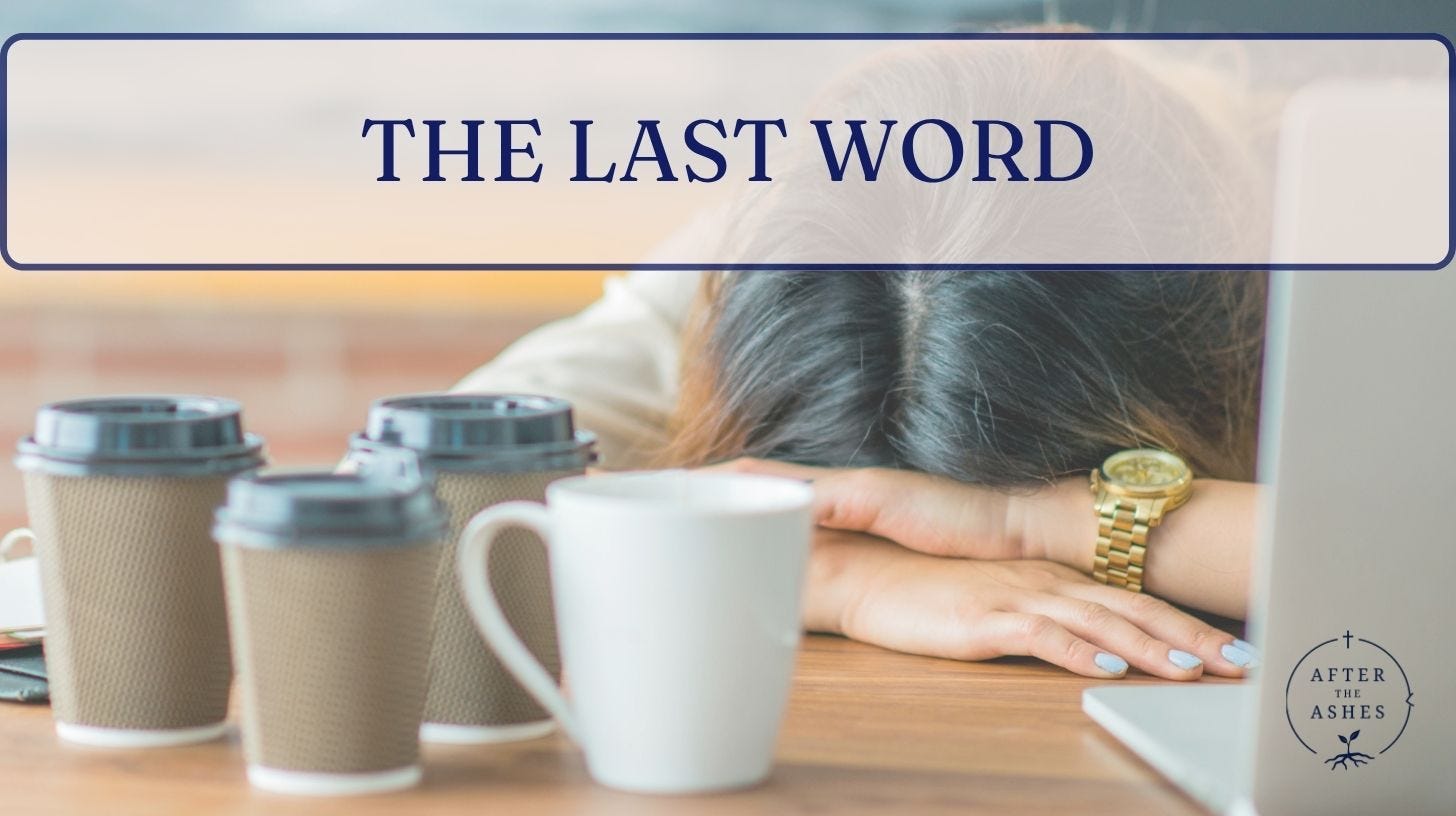
I sat there and thought: I might be the least qualified person alive for this one.
Here’s the resume I’d be bringing to the subject. A divorce I didn’t see coming. A husband lost to suicide — no warning, nothing that made it make sense. A second husband gone just as suddenly, years later. A childhood that left marks I spent a long time learning to set down. An addiction I had to climb out of with my fingernails. And the present-tense part, the part that isn’t past at all: four kids I’m raising by myself, several of them wired in ways the world wasn’t built for, and a retirement account that now feels more symbolic than secure.
That’s the desk I’m writing hope from. You can see the problem.
How do you write about a sunrise from the bottom of a well?
For a while, I thought the honest thing to do was quit. Who was I to tell anyone it gets better, when “better” in my house is a moving target, and some days I’m not sure I believe it myself? I didn’t want to hand someone a postcard of a peace I couldn’t actually locate. I’ve been on the receiving end of that kind of writing — the tidy, glowing kind, apparently composed by people whose hardest day was a flat tire — and it doesn’t comfort anybody. It isolates. It makes you feel like the one broken thing in a world of people who supposedly figured it out.
So I almost closed the laptop.
And then I got stuck on the word last.
The night I didn’t delete the sentence
Tragedy is loud. It walks into your life, and it talks and talks, and for a long stretch, it really does seem to get the final say in everything. Suicide tried to say something about my worth. Sudden death said something about how safe I was ever allowed to feel again. The bank balance has opinions of its own. For years, those voices got to finish every sentence I started about my own life.
A few weeks ago, I was sitting in my recliner, very late in the evening, everyone finally asleep, and I typed one true sentence into this devotional — something small, something I actually believed — and I didn’t delete it. I just looked at it sitting there. And it landed on me slowly that the tragedy hadn’t typed it. I had. The hard things had written a great deal of my story, paragraph after paragraph of it. They had not, as it turned out, written the last line. I was still here. At the table. At midnight. Putting down words they didn’t get to choose.
That was the moment. It wasn’t lightning. Nobody across the room would have noticed a thing — just a tired woman declining to hit the backspace key. But that’s exactly when the tragedy stopped having the last word in my life: the night I understood it was never the one holding the pen at the end.
I think this is what people are grasping at, a little clumsily, when they talk about beauty coming out of ashes. Not that the fire didn’t happen — ashes are the proof it happened. But that the fire doesn’t get to be the final state of the thing. The Old Testament book of Isaiah holds a promise I keep coming back to: ashes can be traded for beauty, and mourning does not get the final word. For years, that verse felt like it was mocking me. Now I read it differently. It’s a promise about who gets the last word over a life. And Someone made it on purpose. It isn’t the fire.
You don’t have to be qualified
If you’re standing in your own wreckage tonight, let me be careful here. I know better than to rush in with a neat little answer for something that has shattered you. I’m not going to tell you it all works out. I don’t know that, and neither does anyone trying to sell it to you in three easy steps.
Here is the only thing I’ve actually got. You do not need a clean story to be useful, and you do not need to feel hopeful before you’re allowed to start writing your way toward hope. The trembling hands count. The draft you weep through counts. The true sentence you type at midnight and refuse to delete — that one counts most of all. You’re allowed to begin before you feel ready, because waiting until you feel qualified is just one more way of handing the pen back to the very thing that’s been writing over you.
So the cursor is still waiting on me to direct its next move. The devotional still isn’t finished. My story is still, by any reasonable measure, a wreck I’m a long way from cleaning up.
But I’m the one at the keyboard now. And the last word was never going to belong to the fire — it belongs to the One who promised me beauty, and to me, deciding to believe Him enough to keep typing.